 Reliable Handyman
Reliable Handyman › Blog › Who Can Fix a Sticking Door or Damaged Door Frame in Hamilton?
← All articlesWho Can Fix a Sticking Door or Damaged Door Frame in Hamilton?
Key takeaways
- Use a handyman or carpenter for ordinary sticking, hinge, strike-plate, casing, and localized jamb repairs.
- Escalate exterior rot, water intrusion, repeated movement, forced-entry damage, and rated doors to the appropriate specialist.
- Photograph the full door, uneven gaps, hinges, latch, strike, threshold, and lower jamb before requesting estimates.
- Compare written scopes, not just prices; ensure exterior repairs address the source of moisture as well as damaged wood.
- Check with the City of Hamilton before work that changes an opening or affects structural framing.
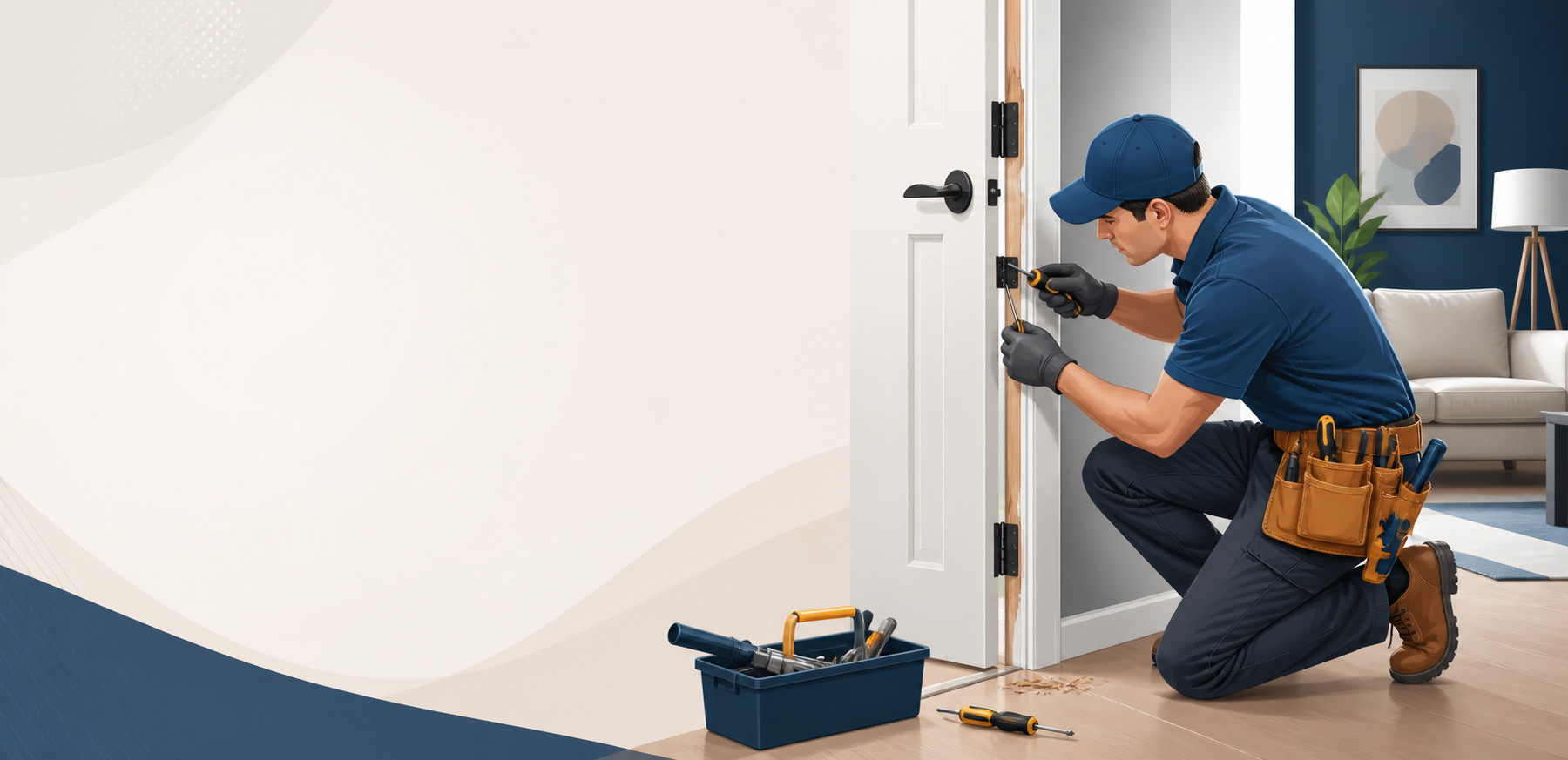
A Hamilton handyman is usually the right first call for a door that rubs, sags, will not latch, or has minor jamb, casing, hinge, or hardware damage. Use a carpenter, locksmith, door specialist, or general contractor instead when there is rot, water intrusion, forced-entry damage, structural movement, or a fire-rated door.
The quick answer: who should you call?
For a typical interior bedroom, bathroom, closet, or basement door, start with a handyman or finish carpenter. They can commonly tighten or replace hinges, reset a strike plate, plane a rubbing door edge, repair minor jamb damage, replace casing, and refit the door.
For an exterior entry door, the right trade depends on what is damaged:
- Lock, deadbolt, latch, or immediate security issue: Call a locksmith.
- Soft wood, peeling paint, water stains, damaged sill, or rot: Call a door-and-window contractor or experienced carpenter.
- Door opening is visibly out of square, wall is cracked, or the problem keeps returning: Call a general contractor or qualified building professional to investigate movement before paying for repeated adjustments.
- Fire-rated, commercial, automatic, condo common-area, or accessibility door: Use a door specialist. Altering a rated assembly or its hardware can affect its performance requirements under the Ontario Building Code.
In Hamilton, Dundas, Ancaster, Stoney Creek, Waterdown, and Binbrook, ask whether the provider will inspect the jamb and surrounding opening, not just shave the door edge. A door can be made to close temporarily while the underlying moisture or frame problem remains.
Hamilton providers worth contacting for the right scope
A recommendation should be treated as a shortlist for due diligence, not a guarantee of workmanship. Confirm current service area, insurance, availability, warranty terms, and the exact repair scope directly with each business.
- Reliable Handyman advertises general repairs and carpentry work in the Hamilton area, including door adjustments, hardware work, interior door fitting, trim, and minor frame repairs. That can make it a sensible first quote for ordinary interior-door issues. See its Hamilton handyman services.
- Hamilton Doors & Windows advertises door-frame, jamb, exterior-frame, and rot-repair work. This is the type of contractor to compare when an exterior door frame has weather damage or may need partial replacement rather than a simple adjustment. See its door frame repair page.
- AEO Services advertises door-frame repair and reinforcement services, which may be relevant after impact or attempted-entry damage. Review its door frame repair and reinforcement service.
When comparing these or other providers, ask each one the same question: “What do you believe is causing the sticking, and what would make this repair expand beyond the initial quote?” The quality of that answer is often more useful than a vague promise to “fix the door.”
Match the symptom to the right professional
| What you see | Likely first call | What the visit should address |
|---|---|---|
| Interior door rubs at the top, sticks, or will not latch | Handyman or carpenter | Hinges, hinge screws, slab alignment, strike plate, door clearance |
| Door drags on carpet, tile, or a threshold | Handyman or carpenter | Hinge sag, changed flooring height, bottom clearance, slab fitting |
| Loose casing or a small dent in the jamb | Handyman or finish carpenter | Trim replacement, localized wood repair, repainting or caulking |
| Deadbolt will not engage or entry door will not secure | Locksmith | Lock alignment, latch, strike, security hardware, emergency access |
| Lower exterior jamb is dark, soft, swollen, or crumbling | Door-and-window contractor or carpenter | Rot extent, sill, weatherstripping, flashing, water entry source |
| Door and nearby wall cracks have appeared or widened | General contractor / building professional | Opening movement, framing, settlement, moisture, structural causes |
| Forced-entry damage around the strike | Locksmith plus door specialist | Secure the opening first, then repair or reinforce the jamb |
Know whether the “frame” is actually damaged
Homeowners often use “door frame” to describe several different components. Naming the correct part helps a provider quote the work accurately.
- Door slab: The moving door panel.
- Jamb: The vertical sides and top member that form the opening the slab closes into.
- Stop: The narrow strip on the jamb that the closed door rests against.
- Casing: Decorative trim covering the gap between wall and jamb.
- Strike plate: The metal plate on the latch-side jamb that receives the latch or deadbolt.
- Threshold or sill: The bottom component of an exterior doorway, designed to manage traffic and weather.
For example, a cracked piece of painted casing beside a bedroom door may be a modest trim repair. A split latch-side jamb behind the strike plate is different: it can affect latching and security. Soft wood at the bottom of an exterior jamb is different again, because the repair should identify where water is entering before new wood is installed.
Use this five-minute door triage before requesting quotes
This article’s Hamilton Door Triage is a practical homeowner checklist, not an industry standard or a substitute for an on-site inspection. It gives you useful evidence to send with a quote request.
1. Make a contact map
Close the door slowly and note the first point of contact. Put a small piece of painter’s tape on the door edge or frame at that location.
- Top hinge-side contact: Often points to loose hinge screws, a worn hinge, or a sagging slab.
- Top latch-side contact: Can indicate swelling, a shifted jamb, or an out-of-square opening.
- Bottom edge scrapes the floor: May be hinge sag, a newly installed floor, or a door that needs refitting.
- Latch hits above or below the strike opening: Usually means alignment needs attention; do not assume the strike plate alone is the cause.
2. Check the gaps with the door closed
Look at the reveal—the visible gap around the slab. Note whether it is consistent or visibly wider at one corner. A gap that is tight at the top and wide at the bottom tells a different story than a door that is uniformly tight along one entire edge.
Take one photograph straight on with the door closed and another from the hinge side. These are more useful than a close-up of a scrape alone.
3. Test the hinges without removing anything
With the door partly open, gently lift the handle-side edge upward. Noticeable movement can support a hinge or screw issue. Look for loose screws, paint-packed hinges, missing screws, or screws that spin without tightening.
Do not force oversized screws into an exterior or security door as a DIY shortcut. A contractor should assess the jamb condition and any concealed wiring or services before drilling deeper.
4. Inspect the bottom 150 mm of an exterior frame
For exterior doors, inspect the lower sections of both jambs, the threshold, weatherstripping, and adjacent trim. Photograph any:
- soft or spongy wood;
- dark staining or recurring paint failure;
- swollen MDF or separated joints;
- gaps in caulking;
- water marks on interior drywall; or
- evidence that rainwater reaches the sill.
This is important because replacing visible trim alone does not solve an active water-management issue.
5. Record the pattern over time
Write down whether the problem began after new flooring, a renovation, a leak, a break-in, or a seasonal weather change. If a door sticks only during humid periods but works normally later, tell the provider. If it sticks every day and the gap is changing, mention that too.
Three examples of what a good repair scope looks like
Example 1: Bedroom door rubs at the top and misses the latch
A good scope may read: inspect and tighten hinges; replace stripped or worn hardware if needed; realign the slab; adjust the strike plate only after confirming the door position; touch up the affected area.
A weak scope is simply: “Plane door edge.” Removing material may hide a sagging-hinge problem without correcting it.
Example 2: Front-door jamb is soft near the threshold
A good scope may include: remove enough trim or damaged material to determine rot extent; inspect sill and adjacent wall condition; identify likely water-entry path; replace affected jamb/trim components; restore flashing, sealant, weatherstripping, and finish as appropriate.
Ask whether painting, disposal, threshold work, and matching exterior trim are included. These are frequent scope gaps in verbal estimates.
Example 3: Strike-side frame split after forced entry
The first priority is securing the home. A locksmith can address urgent lock and latch operation, while a door or carpentry specialist can determine whether the jamb, strike area, door slab, or surrounding frame needs repair or reinforcement. Take photos for insurance before non-emergency cosmetic work begins, if safe to do so.
What to send in a Hamilton quote request
A complete request reduces guesswork and makes quotes more comparable. Send:
1. Your neighbourhood or postal-code prefix and whether it is a detached house, townhouse, condo, or commercial unit.
2. Door type: interior, exterior, patio, storm, steel entry, wood, fiberglass, fire-rated, or commercial.
3. A full photo of each side of the door.
4. Close-ups of hinges, latch, strike plate, threshold, lower jamb, damaged trim, and any soft wood.
5. A short video showing where the door rubs or where the latch misses.
6. The door width and height, if you can measure them.
7. Whether the issue is urgent because the door cannot lock, cannot close, allows water in, or restricts safe access.
8. Known history: leak, impact, flooring replacement, renovation, or recurring seasonal sticking.
Ask for an itemized written estimate separating labour, materials, replacement hardware, finishing or painting, disposal, taxes, and a contingency process for hidden damage.
Permits and safety in Hamilton
A routine adjustment, hinge repair, strike-plate adjustment, or replacement of decorative casing generally differs from work that changes the building opening. The City of Hamilton identifies permits as necessary for construction and renovation work including projects that create, enlarge, or relocate door and window openings; review the City’s current residential building permit guidance before work begins.
Ask the City’s Building Division about the specific scope if the repair involves structural framing, a lintel, exterior-wall changes, fire separations, or a new/enlarged opening. The owner remains responsible for ensuring required permits are in place.
If electrical work is discovered or proposed near the opening, use an appropriately licensed electrical contractor. Ontario’s Electrical Safety Authority contractor lookup lets homeowners verify a Licensed Electrical Contractor rather than relying only on an advertisement.
How to choose between quotes
Do not choose solely on the lowest number. Compare whether each provider has diagnosed the same problem and included the same work.
A useful quote comparison checklist:
- Does the estimate identify the suspected cause, not only the visible symptom?
- Does it specify whether the jamb, casing, door slab, strike plate, or threshold is being repaired?
- For exterior damage, does it address moisture entry rather than only replacing rotten wood?
- Are hardware, paint, caulking, disposal, and return visits included or excluded?
- Does it explain what happens if concealed rot or wall damage is found?
- Can the business provide proof of current liability insurance if requested?
- Is there a written workmanship warranty and a clear payment schedule?
For a small adjustment, one qualified handyman quote may be enough if the diagnosis is straightforward. For exterior rot, repeated misalignment, security damage, or a possible structural issue, obtain at least two written scopes from providers with relevant experience.
FAQ
Can a handyman fix a door that rubs against the frame?
Usually, yes. A handyman can often correct loose hinges, worn screws, minor alignment problems, strike-plate issues, and small jamb or trim repairs. Use a carpenter or specialist if the door has recurring alignment problems, significant frame damage, rot, or an exterior weatherproofing issue.
Can a damaged door frame be repaired without replacing the door?
Yes. Casing, localized jamb damage, hinges, strikes, and some sections of exterior trim can often be repaired while keeping the existing door slab. Replacement becomes more likely when the slab is warped, the jamb is extensively rotten, the frame is compromised, or the opening itself has moved.
When is a sticking door an urgent problem?
Treat it as urgent when an exterior door cannot lock, an occupied room cannot be opened safely, a fire-rated door does not close properly, there is active water entry, or forced-entry damage has weakened the latch-side frame. Contact a locksmith for immediate lock or entry security issues.
Do I need a permit to repair a door frame in Hamilton?
Ordinary adjustments and minor non-structural repairs are different from enlarging, relocating, or creating an opening. A permit may be required when work affects structural framing, an exterior wall, or other regulated conditions. Confirm the exact project with Hamilton’s Building Division before starting.
What is the most useful photo to send a door repair contractor?
Send a short video of the door closing, plus full-door photos and close-ups of the hinges, latch, strike, threshold, lower jamb, and damage. A straight-on photo with the door closed is especially helpful because it shows uneven gaps around the slab.
> Disclaimer: This article is general home-repair information, not a diagnosis, engineering opinion, permit determination, quote, or endorsement of any provider. Confirm present-day service availability, insurance, qualifications, pricing, warranty terms, and permit requirements before authorizing work.
References
- https://reliable-handyman.ca/service-areas/hamilton
- https://reliable-handyman.ca/services/general-repairs
- https://reliable-handyman.ca/services/carpentry
FAQ
Can a handyman fix a door that rubs against the frame?
Usually, yes. A handyman can often correct loose hinges, worn screws, minor alignment problems, strike-plate issues, and small jamb or trim repairs. Use a carpenter or specialist if the issue keeps returning or involves rot, major frame damage, or exterior weatherproofing.
Can a damaged door frame be repaired without replacing the door?
Yes. Casing, localized jamb damage, hinges, strikes, and some exterior trim can often be repaired while keeping the existing door slab. Replacement may be needed when the slab is warped, the jamb is extensively rotten, or the opening itself has moved.
When is a sticking door urgent?
It is urgent when an exterior door cannot lock, an occupied room cannot be opened safely, a fire-rated door will not close properly, water is entering, or forced-entry damage has weakened the frame. Call a locksmith for immediate lock or security issues.
Do I need a permit to repair a door frame in Hamilton?
Routine adjustments and minor non-structural repairs differ from creating, enlarging, or relocating an opening. Ask Hamilton’s Building Division about permits when the work affects structural framing, an exterior wall, fire separation, or the size or location of the opening.